Some Upcoming Events

The Society’s lecture series for 2014-15 has now completed. We will host a number of events after the summer. These events include:

‘The Glorious Madness’ – a talk by Turtle Bunbury, historian and author, on Irish involvement in the First World War, 13 October 2015.

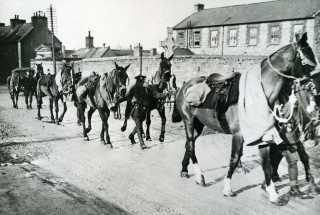
British Army leaving  Custume Barracks, 1922

The British army leaving Custume Barracks, Athlone, 1922. The photo was taken from an original album once owned by Sean MacEoin. Thanks to Gearoid O’Brien for information on the photo, which is now stored in the Aidan Heavey Public Library.

‘Conference on the history and archaeology of Athlone’ – Following the success of our conferences on the Irish War of Independence (2011) and Irish Civil War (2013) which were addressed by many leading Irish and international historians, the Society will host a conference on Athlone. The conference will also mark the fiftieth anniversary of the Society, 28 November 2015.

‘Destiny of the Soldiers’ – a talk by Dr. Donnacha Ó Beacháin, Dublin City University. Among many other works, Dr. Ó Beacháin is the author of Destiny of the Soldiers, Fianna Fáil, Irish Republicanism and the IRA 1926-73, (Gill & Macmillan, Dublin, 2010), January/February 2015.

The latest edition of the Society journal, which is devoted to the Irish Civil War, will be published in advance of the November Conference.

Field Trip: Please note that the Society will take a field trip to Limerick, including visits to the Hunt Museum, St, John’s Castle, and Sarsfield Barracks on 12 September 2015. For details, and to book a place, contact midlandconference@gmail.com or athlonehistory@gmail.com.

Posted in Field Trips, Lectures | Leave a comment

The Billy English Memorial Lecture, 2015 – Athlone in the 1960s

Wednesday 15th April, 8pm, Wineport Lodge

– Talk by Dr Harman Murtagh

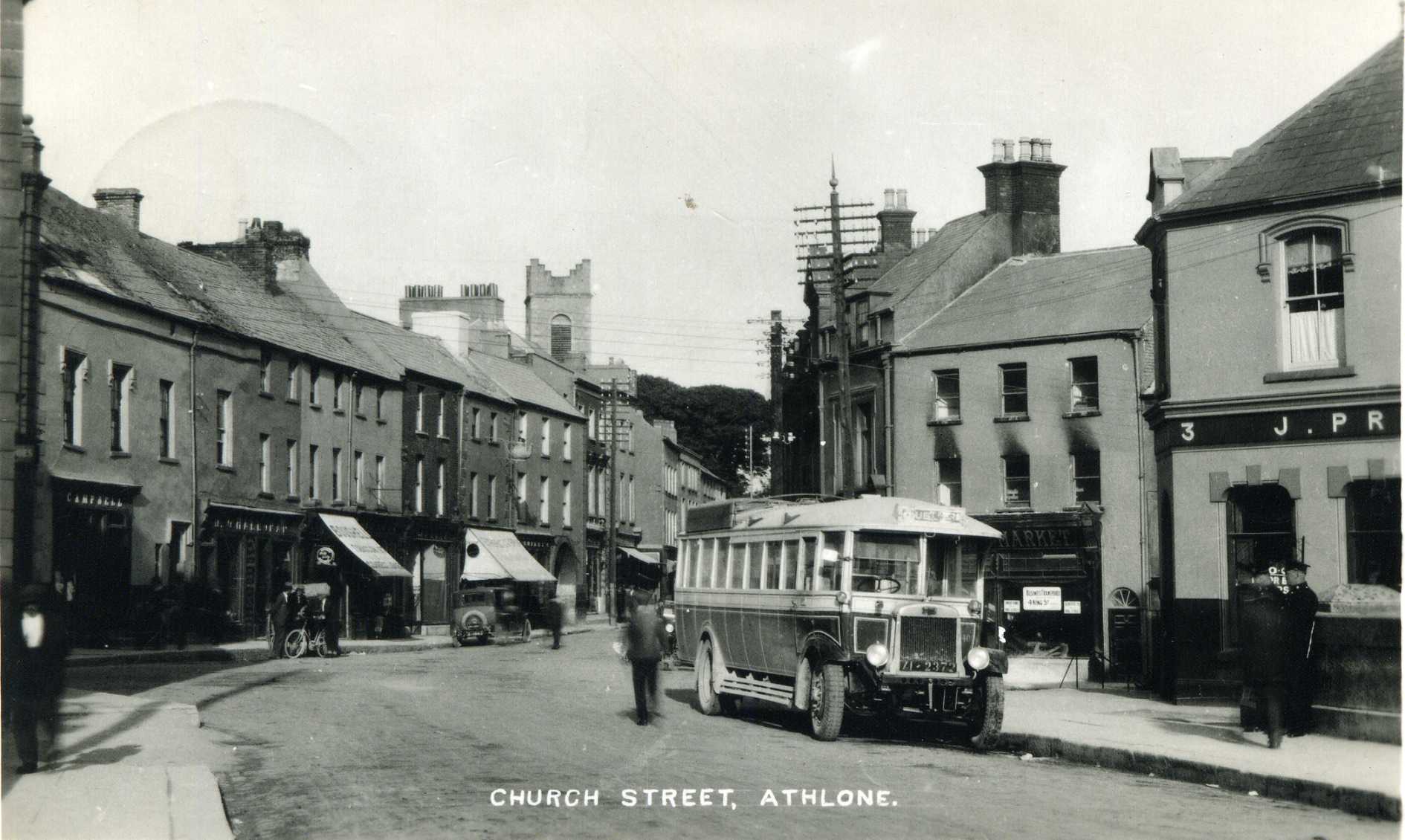
Church Street, Athlone

Church Street, Athlone, in the mid-Twentieth Century (Aidan Heavey Public Library, Athlone)

Summary – The 1960s was the era of the Beatles, the mini skirt, the Congo, Christine Keeler, the vernacular Mass and the proposal to demolish Athlone Castle. At the start of the decade, leaders like John F. Kennedy, Pope John XXIII and the then Taoiseach Sean Lemass offered society a fresh style, new hope and ideas which from 31 December 1961 were transmitted into Irish homes by RTE. Some conservative forces struggled to come to terms with these new concepts.Towards the end of the decade, the mood darkened with start of the long Northern agony, disappointment with Harold Wilson’s Labour government in Britain, Pope Paul VI’s Humanae vitae encyclical and the acceleration of the Vietnam War. This lecture will focus on the impact of the changing 1960s culture on Athlone and the local responses to it, as viewed through the pages of the Westmeath Independent and the excellent photographic archive of Athlone Library.

Speaker – Dr Harman Murtagh is a native of Athlone. He joined The Old Athlone Society on its foundation, later serving as president. He is currently president of the Military History Society of Ireland and a vice-president of the Group for the Study of Irish Historic Settlement. He is a visiting fellow at Athlone Institute of Technology. He is the author of numerous publications including the definitive Athlone History and Settlement to 1800.

The N.W. English Memorial Lecture – This memorial lecture is held every year to commemorate Norman William (Billy) English, a founder member and honorary secretary of The Old Athlone Society since its inception in 1965, until his sudden death at the age of 56 in February 1978. Billy was an auctioneer in Athlone. While not a professional historian and antiquarian, his endeavours for many years were connected with the history and development of Athlone and its hinterland. He demonstrated that he had a true historian’s instinct with which he developed a deep knowledge of, and affection for, his native region.

To The Athlone Society, he left a legacy of a thriving historical society, a museum that later became The Athlone Castle Museum and a journal often used for reference by historians. Highly regarded as a lecturer, he was in constant demand by historical societies in all parts of the country. Billy frequently contributed articles to many historical journals including: Journal of the Royal Society of Antiquaries in Ireland; The Irish Sword; and Journal of The Old Athlone Society. Living as he did near Goldsmith country and Lough Ree meant that he was an authority on Oliver Goldsmith, the inland waterways of Ireland and being a keen sailor wrote: Lough Ree Yacht Club 1770-1970 a memoir, to mark the bicentenary of the club.

The Old Athlone Society each year holds a lecture in his memory. It is therefore fitting, on the occasion of the society’s fiftieth anniversary, that the memorial lecture is being held for the first time in Wineport Lodge. This highly-regarded restaurant and hotel sits in a beautiful location on the shores of Lough Ree and is owned by Billy’s daughter, Jane, and her husband, Ray Byrne. The Society will be honoured by the presence of some members of the English family: Billy’s Widow Dorothy; sons, Richard, Robert, David; daughters, Jane, Sarah; many grandchildren; his brother Cecil; and Dorothy’s husband, Robin Baird.

Posted in Lectures | Leave a comment

Protected Structures on the Shannon

Wednesday 4th March, 8pm, Lough Ree Yacht Club

– Talk by Garrett O’Neill

View of Castle Keep and River

A view of the Castle Keep and Shannon River, Athlone (Aidan Heavey Public Library, Athlone)

Summary – Waterways Ireland was established as part of the Belfast or ‘Good Friday’ agreement with responsibility for the navigable inland waterways of the entire island. Part of its remit is a duty to safeguard both built and natural heritage of the waterways. Therefore in the summer of 2008 Waterways Ireland commissioned a survey of the historic structures located within 50 metres of the shorelines of the Shannon Navigation, from the north end of Lough Allen to Sarsfield Lock in Limerick.

Cathal O’Neill Architects were awarded the project and undertook the work from late September 2008 to April 2009. This talk will describe the scope of the work, the methodology adopted and an account of the fieldwork undertaken with particular reference to the compilation of the database presented to Waterways Ireland. The talk, which will be illustrated and cover the entire river, will be approximately 45 minutes long and followed by an open discussion.

Speaker – Garrett O’Neill graduated in Architecture in 1984.He is a principal in Cathal O’Neill Architects, established in 1961 by Professor Cathal O’Neill. Garrett holds a master’s degree in Urban and Building Conservation and is a member of council and current Hon Treasurer of the Royal Institute of the Architects of Ireland. From the age of seven he has spent most of his free time on, in, or around Lough Ree. He is an accomplished Shannon One Design sailor.

Posted in Lectures | Leave a comment

Personal reflections on the history and achievements of the Abbey Theatre

Wednesday 4th February, 8pm, The Little Theatre, St Mary’s Place, Athlone

 – Talk by Senator Fiach MacConghail, Director of the Abbey Theatre

Summary – Senator Fiach Mac Conghail is marking his 10th anniversary as Director of the Abbey Theatre in 2015 and will present his personal reflections on the history of the Abbey Theatre and its role as Ireland’s national theatre.

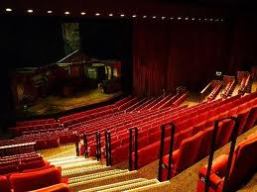
Abbey Theatre

The Abbey Theatre, Dublin

Speaker – Senator Fiach Mac Conghail has been Director/CEO of the Abbey Theatre since May 2005. The Abbey Theatre is Ireland’s national theatre and Fiach is responsible for its artistic programming and strategic management. He has produced over 100 productions for the Abbey Theatre, at home and abroad, including plays by Brian Friel, Tom Murphy, Frank McGuinness, Marina Carr, Paul Mercier, Mark O’Rowe, Sebastian Barry, Owen McCafferty, Carmel Winters and Sam Shepard, including 28 world premieres.

Fiach was Arts Adviser to the Minister for Arts, Sport and Tourism (2002-2005). He has worked on many cultural projects and festivals on behalf of the state including, Ireland’s Presidency of the EU (2004), Centre Culturel Irlandais, Paris (2001-2003), EXPO (2000), Venice and Sao Paulo Biennales of Visual Arts (1996-7). He was Artistic Director of Project Arts Centre from 1992 – 1999. He is a graduate of Trinity College, Dublin and was awarded the prestigious Eisenhower Fellowship in 2004. He is a founding member of the National Campaign for the Arts. Fiach Mac Conghail is an Independent Senator having been nominated by An Taoiseach Enda Kenny in 2011. He was honoured by the French Government with a Chevalier de L’Ordre des Arts et des Lettres in 2013.

Posted in Lectures | Leave a comment

Irish Soldiers, American Wars – From Buena Vista to Wounded Knee

Wednesday, 14 January 2015, 8pm, Officers’ Mess, Custume Barracks, Athlone

– talk by Ian Kenneally

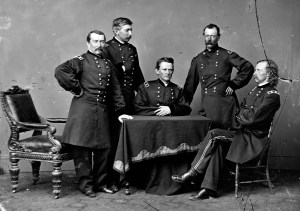
Philip Sheridan and George Armstrong Custer

General Philip Sheridan is standing on the far left with George Armstrong Custer seated on the far right (US Library of Congress).

Summary – This talk will examine the role of Irish soldiers in some of the extraordinary events that led to the creation of the modern United States. It will begin with the Mexican-American War of 1846-48. Thousands of Irish soldiers,most of them newly-arrived immigrants, fought for the US army. However, some of those troops remain famous to this day because of the fact that they deserted to join forces with the Mexican army. This talk will explain the role of the ‘San Patricios’ and the wider Irish role in the war.

The society has recently heard an excellent lecture on the Irish in the American Civil War so this talk will give only a very brief recap of the Irish involvement in that war. When the civil war ended in April 1865, there were tens of thousands of well trained and battle hardened Irish soldiers, of whom many had command experience. Most of these soldiers returned to civilian life in the post-war United States but some remained militarily active.

We will then move through the period from 1865 to 1890 and will discuss the less well-covered involvement of the Irish in battles across the North American continent during those years. It will begin with the Irish Republican Brotherhood and the so-called Fenian invasions of Canada in 1866 and 1870. We will also cover the Plains Wars against the Native Americans, detailing such iconic events as the Battle of the Little Bighorn in 1876 and the massacre at Wounded Knee in 1890.

The talk will demonstrate some of the many challenges that faced the Irish in their quest to build a new life in a new continent amid confusing and often bloody times. The prolonged struggle to control the vastness of North America had profound consequences for world history. Yet, the rush to create of a new nation left many casualties in its wake. This talk hopes to give listeners a sense of the complexities of life in 19th century America and the important role of Irish soldiers in those remarkable times.


Speaker – Our speaker will be Ian Kenneally who is currently a doctoral student at NUI Galway. He previously completed an MPhil in history at UCC. His publications include ‘The Paper Wall: Newspapers and Propaganda in Ireland, 1919-1921’, ‘From the Earth, a Cry: The Story of John Boyle O’Reilly’, and ‘Courage and Conflict: Forgotten Stories of the Irish at war’ (Collins Press). He has contributed chapters to a wide variety of publications including ‘Irish Journalism before Independence’ (Manchester University Press), ‘Independent Newspapers: A History’ (Four Courts Press), and the recently published Periodicals and Journalism in Twentieth Century Ireland (Four Courts Press). He is a contributor to the forthcoming ‘Atlas of the Irish Revolution’ (Cork University Press) and the Old Athlone Society’s special edition on ‘The Irish Civil War in the Midlands’.

Ian has contributed articles to many newspapers and journals. He is a regular speaker at conferences and events across the country, and abroad, and he has provided research for documentaries on BBC, TG4, and RTE Radio One, among others. Ian recently wrote and produced a radio documentary, in conjunction with the Broadcasting Authority of Ireland, on the life of John Boyle O’Reilly. This documentary, ‘The Cry of the Dreamer’, has been broadcast in Ireland and Australia, and will be broadcast in the United States. He is currently producing a documentary about the Connaught Rangers entitled ‘You Are to be Shot at Daybreak’, one of a number of radio projects.

Posted in Lectures | Tagged , , , , | Leave a comment

Priests, Patriots, Propagandists: Irish clergy in pre-Fascist Rome

Wednesday, 3rd December 2014, 8pm, The Prince of Wales Hotel

– talk by Dr. Mark Phelan

Summary – During the revolutionary period, the Irish College Rome effectively acted as an interface between Sinn Féin and the Vatican. Keen political strategists, the College authorities also provided republican diplomats with an expert reading of secular affairs in Italy, and involved themselves in a wide variety of propaganda initiatives designed to elicit support for the Dáil government. Addressing each of these topics in turn, this paper will highlight the important role played by expatriate Irish clergy during the crisis period of the Anglo-Irish conflict.

Speaker – Dr Mark Phelan. A graduate of the National University of Ireland, Dr Mark Phelan is an early career historian. His work to date has focused on the Irish experience of the First World War, and on the Irish Revolution and its aftermath in an international context.

Posted in Lectures | Leave a comment

Cousins in Arms: Irish and Australians at Gallipoli

Tuesday 18th November 2014, 8pm, The Officers’ Mess, Custume Barracks, Athlone

– talk by Prof. Jeff Kildea

University College Dublin & University of New South Wales

H.E. Dr. Ruth Adler, Australian Ambassador and Mr. Zeki Guler, Counsellor at the Turkish Embassy in Dublin, will be attending.

Australian Ambassador to Ireland

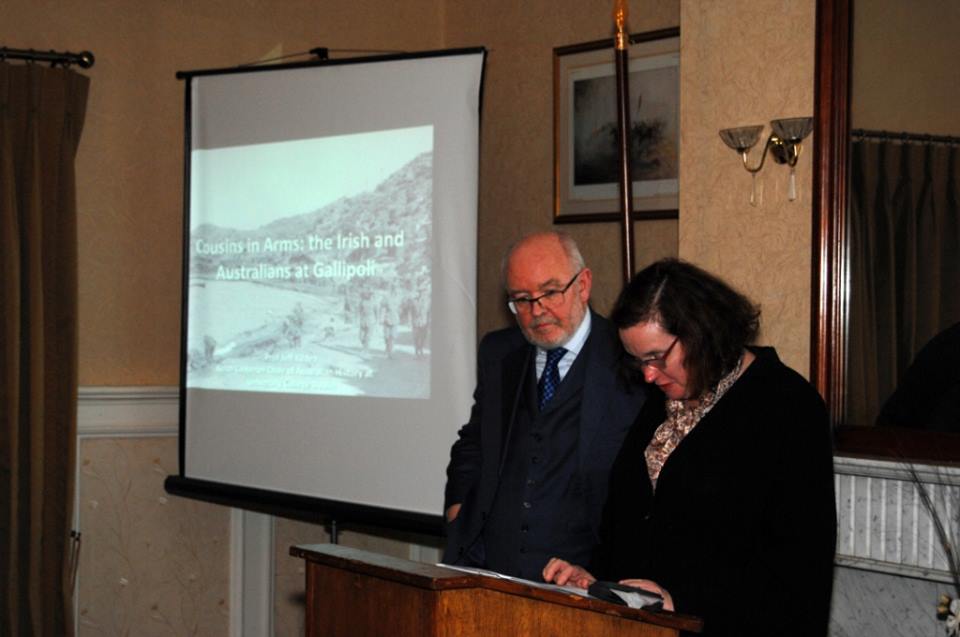
Dr. John Keane and H.E. Dr. Ruth Adler (The Old Athlone Society)

Summary – Prof Kildea will outline the history of this military adventure that resulted in the death of many Irish soldiers alongside their Australian comrades at Gallipoli, in 1915, which is a relatively forgotten aspect of our military history. Stalemate on the Western front led to Winston Churchill’s ill-conceived initiative to bring about the end of the World War One. This involved the Allied forces attempting to gain control of the strategic sea route to Constantinople (Istanbul) through the narrow straits of the Dardanelles (Canakkale Bogazi) in Turkey.

Until April 1915, few Irish or Australians had been aware of the Turkish area of Gallipoli. However, by December 1915, Gallipoli would become synonymous with slaughter. The Turks also lost thousands of men defending their country under the command of Mustafa Kemal who, in 1934, as president of the new Turkey in recognition of the bravery and sacrifice of the Australian and New Zealand forces had the following inscribed on the Anzac memorial:

Those heroes that shed their blood
and lost their lives…
You are now lying in the soil of a friendly country.
Therefore rest in peace.
There is no difference between the Johnnies and the Mehmets
to us where they lie side by side now
here in this country of ours…
you, the mothers, who sent their sons from faraway countries
wipe away your tears;
your sons are now lying in our bosom
and are in peace.
After having lost their lives on this land
they have become our sons as well.

ATATURK, 1934

Posted in Lectures | Leave a comment

Remembering Richard Hayward: 1892-1964

Lough Ree Yacht Club – 22 October, 2014, 8pm

– talk by Paul Clements

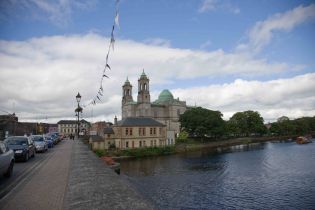
Athlone, Shannon River

A modern view of the River Shannon running through Athlone

On the 22nd October 2014, at 8pm, the Society will host a talk by Paul Clements. Paul will show a rare film by Richard Hayward about his journey down the River Shannon in 1939.

This film, Where the Shannon Flows Down to the Sea, is a glimpse of a lost world.  The talk will be held at Lough Ree Yacht Club. Paul Clements has completed a biography of Richard Hayward. Romancing Ireland: Richard Hayward 1892-1964, Lilliput Press, Dublin, 2014.

Summary – Richard Hayward was a well-known author of many travel books dealing with different parts of Ireland including Where the River Shannon Flows George Herrap & Co. Ltd. London 1940. Hayward set out from Belfast on 16 August 1939 together with Germaine Berger in charge of the movie camera and Louis Morrison with still cameras, who had the task of illustrating the book. In the preface to the book he stated:

“Our objective was three fold: to make a travel picture of the River Shannon from its source to its mouth; to write a book of similar scope; and to enjoy ourselves. We enjoyed ourselves so much that the other two parts for mission were accomplished almost without conscious effort”

Paul Clements’s talk encompasses the use of slides, and will cover the long and varied career of Richard Hayward whose many books were illustrated by the renowned artist Raymond Piper. He will also show the film that Germaine Berger made while journeying along the river, containing footage of Athlone in 1939.

Speaker – Paul Clements is a journalist, broadcaster and writer based in Belfast. He is the author of three travel books about Ireland and major works of biography and criticism. His landmark biography on the Irish travel writer, Richard Hayward was published in 2014. Romancing Ireland, Richard Hayward 1892-1964 tells for the first time the fascinating life story of one of Ireland’s leading cultural figures of the mid-twentieth century. His remarkable journey around every county in Ireland in search of the highest point is recounted in the best-selling book The Height of Nonsense in 2005. His odyssey through the Burren in Co Clare is captured in the lyrical Burren Country, Travels through an Irish limestone landscape, published in 2011, and his book on the coast of Ireland, Irish Shores: A Journey Round the Rim of Ireland came out in 1993.

His special interests are peoples’ connection to the landscape and the oral tradition, as well as built heritage and natural history. Since 2007, after leaving the BBC where he was a journalist in Belfast and London, Paul has co-written guidebooks to Ireland for Fodor’s, Insight and the Rough Guide. A regular contributor to The Irish Times, he has written more than 25 ‘Irishman’s Diaries’ as well as other features on cultural life, the arts and heritage. He has also written widely about the much-acclaimed travel writer Jan Morris, including a critical study, and in 2006 edited a book of 80th birthday tributes to her.

Posted in Lectures | Leave a comment

Field trip to Clonfert Cathedral and Meelick Church

Saturday, 20th September, 2014, 12pm, Clonfert Cathedral

– with a talk by Dr. Christie Cunniffe

Clonfert Cathedral, Galway

Clonfert Cathedral, County Galway (The Old Athlone Society)

Posted in Field Trips | Leave a comment